

🚀 Introducing Eclipse Mosquitto 2.1 — Smarter, Faster, and Now with a Web UI
As the company behind Eclipse Mosquitto, we at Cedalo are proud to announce the release of Mosquitto 2.1 — a major upgrade that brings unprecedented visibility, performance, and extensibility to the world’s most widely used open-source MQTT broker.
With this release, Mosquitto becomes easier to monitor, simpler to extend, and more secure to operate — empowering both developers and enterprises to build scalable, reliable MQTT infrastructures.
And for the first time ever, Mosquitto now includes a built-in Web UI that provides instant visibility into your broker’s live activity.
🖥️ A Web UI for Instant Broker Insights
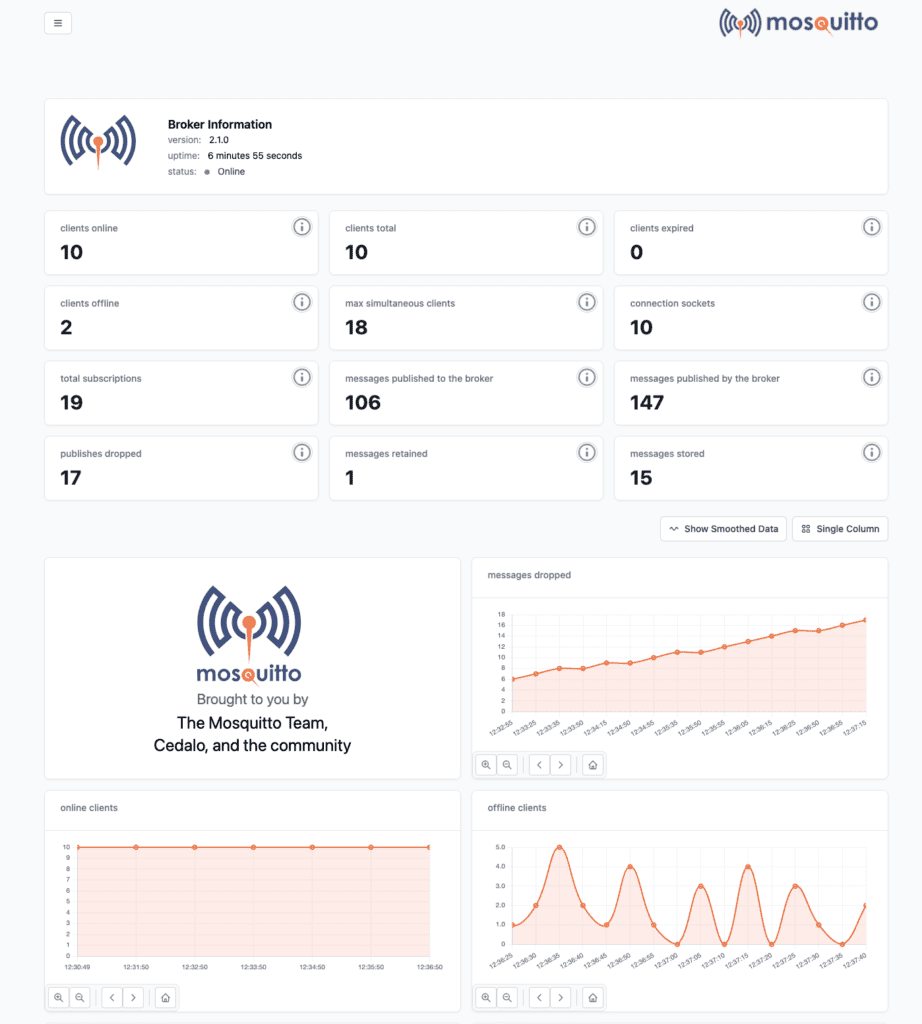
The new Mosquitto Web UI introduces a user-friendly dashboard that visualizes real-time broker metrics powered by $SYS topics.
It provides a clear overview of:
- Connected clients and active sessions
- Message throughput and topic activity
- Retained topics and system uptime
- Broker health and performance metrics
This new interface eliminates guesswork and simplifies operations — making MQTT more transparent and approachable for developers, system integrators, and enterprise operators alike.
It’s a major step forward in Cedalo’s mission to make Mosquitto not only the most efficient MQTT broker — but also the easiest to understand and manage.
🔐 Stronger Security and TLS Flexibility
Security remains at the heart of Mosquitto, and version 2.1 strengthens that foundation with more flexibility and modern best practices.
- TLS key logging support for advanced debugging with Wireshark
- Optional acceptance of expired certificates for controlled compatibility
- Bridges can now use OS certificate stores (
bridge_tls_use_os_certs) - Removal of deprecated TLS v1.1 for stronger encryption defaults
- ACLs and password files migrated to plugins, laying the foundation for modular authentication
These changes bring Mosquitto up to date with modern security standards while keeping configuration simple and consistent.
🧩 A New Era of Plugin Flexibility
Mosquitto’s plugin system has been expanded to give developers and integrators more power and precision.
Plugins can now react to more broker events, modify messages dynamically, and handle advanced authentication logic.
Highlights include:
- New event hooks (
CONNECT,SUBSCRIBE,UNSUBSCRIBE,CLIENT_OFFLINE) - Outgoing message modification support
- Delayed authentication and improved control flow
- Plugin discovery and metadata via
$CONTROLtopics - Self-contained, isolated plugin loading for reliability and simplicity
With these upgrades, Mosquitto 2.1 becomes a truly extensible MQTT platform, ready to integrate with monitoring, policy enforcement, and analytics systems.
⚡ Smarter, Faster, and More Efficient
Performance and scalability have always defined Mosquitto — and 2.1 takes both even further.
- Idle CPU usage reduced up to 100×
- Memory usage optimized for packet handling and client management
- Smarter keepalive management for high connection density
- Global configuration limits (
global_max_clients,global_max_connections) - New
--test-configoption for pre-deployment validation - Container-friendly environment variables (PUID/PGID) and systemd watchdog support
The result is a broker that handles more clients with fewer resources — ideal for industrial, edge, and large-scale cloud scenarios.
🌐 Modern Networking and WebSocket Support
Mosquitto 2.1 introduces a new built-in WebSocket implementation, replacing external dependencies like libwebsockets with a faster, more reliable solution.
Additional updates include:
- PROXY protocol v1/v2 support for better load balancer integration
- Optional origin validation for WebSocket security
- Support for X-Forwarded-For headers for accurate client IP tracking
- Expanded Windows support (up to 8192 connections and multi-instance service mode)
These enhancements make Mosquitto simpler to deploy in modern, cloud-based environments.
🔄 MQTT 5.0 and Bridge Improvements
Bridges and protocol compliance have also received major upgrades:
- Broker-created topic aliases for more efficient MQTT v5 message routing
- New options for
bridge_receive_maximumandbridge_session_expiry_interval - Improved bridge reconnection and backoff logic
- Enhanced error handling for shared subscriptions
These changes strengthen Mosquitto’s reliability in distributed deployments and hybrid IoT topologies.
🧱 New Plugins and Dynamic Security Enhancements
Mosquitto 2.1 adds new official plugins that extend functionality and simplify enterprise use cases:
- ACL-file and Password-file plugins — modular replacements for legacy options
- Persist-SQLite plugin — enables persistence to SQLite databases
- Sparkplug-aware plugin — adds native compatibility with industrial Sparkplug B implementations
The Dynamic Security Plugin also receives new capabilities:
- Support for
%c(client ID) and%u(username) patterns - Role-based wildcard restrictions
- Automatic default-role generation
- Deferred disconnections to complete message acknowledgments
Together, these updates make Mosquitto easier to secure, customize, and manage dynamically.
🔧 Migration Made Simple — Powered by Cedalo
At Cedalo, we understand that upgrades can be complex — especially when long-running systems rely on older configuration formats.
To make the transition to Mosquitto 2.1 seamless, we’ve developed migration tools that automatically convert your legacy setups to the new ecosystem.
- ACL & Password File → Dynamic Security Plugin Conversion — Quickly migrate to Mosquitto’s modern, centralized security model without losing your existing user and role data.
- Persistence (.db) → SQLite Conversion — Convert traditional Mosquitto persistence files to SQLite databases for easier analysis, portability, and debugging.
These tools are provided by Cedalo to help users modernize and prepare for the future of Mosquitto and Pro Mosquitto, where flexibility and observability are standard.
💼 From Open Source to Enterprise — The Cedalo Advantage
As the official maintainers of Eclipse Mosquitto, Cedalo ensures that open-source innovation and enterprise reliability go hand in hand.
With Pro Mosquitto and the Cedalo MQTT Platform, we extend Mosquitto’s capabilities with:
- Centralized Web-based management and monitoring
- Dynamic security and fine-grained access control
- High availability and clustering
- Enterprise analytics and long-term observability
Whether you’re running a single broker or an enterprise-scale MQTT architecture, Cedalo provides the technology and support to help you grow with confidence.
🌟 A New Era for Mosquitto
Eclipse Mosquitto 2.1 is more than an update — it’s a leap forward in usability, extensibility, and performance.
With its built-in Web UI, smarter plugin system, modernized security, and Cedalo-provided migration tools, it sets a new standard for open-source MQTT.
At Cedalo, we’re proud to lead this evolution — powering both the open-source foundation and the professional-grade extensions that help organizations build reliable, scalable, and secure MQTT solutions.
Eclipse Mosquitto 2.1 — faster, smarter, and now visible at a glance.
Proudly developed and maintained by Cedalo, the company behind the MQTT Platform and Pro Mosquitto.
✅ Take Control of Your MQTT Infrastructure
Eclipse Mosquitto 2.1 is a massive leap for the community, bringing visibility directly into the broker. Whether you’re running a single instance or scaling across the enterprise, Cedalo is here to support your journey.
- Enhance Your Setup with our Free Tier: Take your management to the next level by connecting your Eclipse Mosquitto 2.1 broker to the Cedalo MQTT Platform Free Tier. It’s the perfect way to explore advanced management features for free.
- Go Professional with Pro Mosquitto: For mission-critical deployments, Pro Mosquitto adds high availability clustering, advanced security features, integrations and expert support to the performance you already trust.
- Seamless Migration: Don’t let legacy configs hold you back. Use our migration tools to move your ACLs and persistence files into the modern Mosquitto era.


